If you’re reading this at 2 a.m. after your third trip to the bathroom tonight, you already know why you’re here. I’m not going to spend three paragraphs describing what an enlarged prostate feels like — you’re living it. Let’s just get into whether this particular supplement is worth your money.
PrimeGENIX Prostate Support (they call the formula “Prostate Complex” internally) is pitched as a step up from the usual saw-palmetto-and-hope approach. The company’s angle is that most prostate supplements only fight swelling, while theirs also targets bacteria that can aggravate symptoms. That’s a specific, testable claim, so that’s where I started.
What’s Actually In It
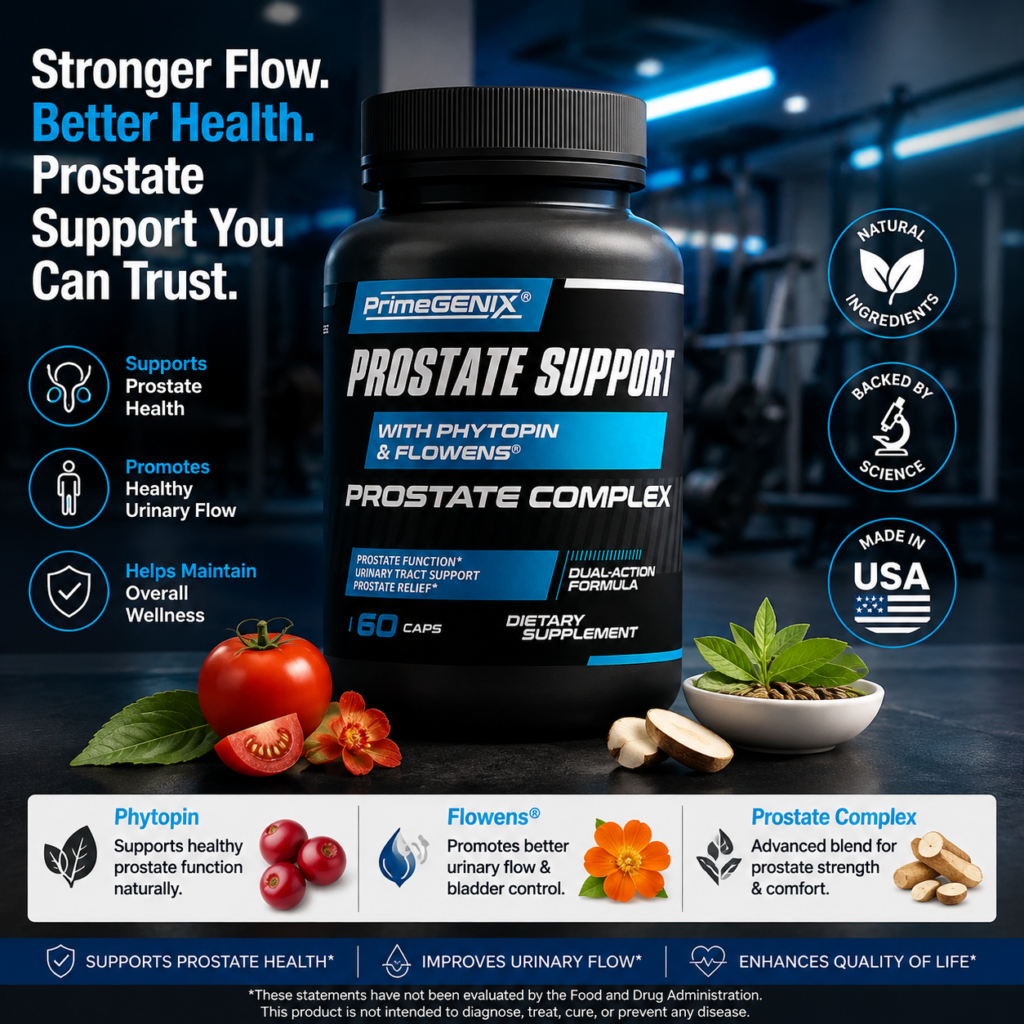
Fifteen ingredients total, but four of them are doing the heavy lifting, according to PrimeGENIX itself:
Phytopin® — a patented beta-sitosterol extract sourced from pine. Beta-sitosterol is genuinely one of the better-studied compounds in this whole category. A Cochrane systematic review pooling 519 men across four randomized, placebo-controlled trials found it meaningfully improved urinary symptom scores and flow rate compared to placebo, though it didn’t shrink the prostate itself in those trials — worth flagging given PrimeGENIX’s “shrinks swollen prostate” claim. A more recent 2023 review in the American Journal of Clinical and Experimental Urology covers the proposed mechanism (it appears to partially inhibit the same enzyme that finasteride targets) and notes it’s generally less potent than prescription options, but real. This isn’t a fringe ingredient dressed up with a fancy name — it’s one of the few things in the natural prostate-support world with actual randomized trial data behind it.
Flowens™ — a cranberry extract specifically formulated for men, which is the ingredient behind the “flushes bacteria” half of the pitch. This one’s genuinely well-matched to the claim: there’s a double-blind, randomized, placebo-controlled study on Flowens by name, published in the World Journal of Urology, showing improved LUTS in men. It builds on earlier work from the same research group — a six-month trial of cranberry powder in men with urinary symptoms and elevated PSA, which found real improvements in flow rate, symptom scores, and residual urine volume. Cranberry’s general anti-adhesion mechanism against bacteria is also well documented in a prostate-radiotherapy patient study. That’s a stronger evidence trail than most cranberry-containing prostate formulas can claim, since a lot of them just toss cranberry in for the halo effect without using a studied form of it.
Graminex® G63® — rye pollen extract, sold elsewhere as Cernitin or Cernilton. This one’s been kicking around in European BPH treatment for decades. A Cochrane/BJU International systematic review found it improved self-rated urinary symptoms and reduced nocturia compared to placebo, though — like beta-sitosterol — it didn’t significantly improve flow rate or shrink the prostate in that pooled data. An older but detailed 12-week clinical trial reported measurable increases in urine flow and drops in residual volume with long-term use. It’s the ingredient I was most pleasantly surprised to see included — a lot of competitors skip it because it’s pricier than saw palmetto.
LycoRed® Lycopene — a patented, well-absorbed lycopene source. The prostate cancer prevention angle for lycopene gets thrown around a lot online; the honest state of the research is “promising but not settled.” A 2013 mechanistic review lays out the lab and animal evidence but is explicit that clinical proof in humans is still thin, and a more recent meta-analysis of RCTs found lycopene supplementation didn’t move the needle on PSA levels in men who already had prostate cancer. This product doesn’t lean hard on the cancer-prevention claim, which is the more defensible way to position it — here it’s framed as general antioxidant support, which the evidence supports more comfortably than a disease-prevention claim would.
Then there’s the supporting cast: saw palmetto, stinging nettle root, pygeum africanum, zinc, selenium, and boron — all standard, all reasonable inclusions, all things you’d expect to see in literally any prostate formula on the market. Nothing wrong with them, nothing that differentiates this product either.
Here’s My Actual Hesitation
The company’s page cites specific numbers — a 53% improvement in urine flow, a 54% reduction in residual bladder volume, a 22.5% average PSA reduction. Those aren’t numbers I’d expect a company to just invent; they line up with the kind of results you actually see in published beta-sitosterol and Flowens research. But — and this matters — those are results from studies on the individual ingredients at specific doses, not from a clinical trial on this exact product. That’s a meaningful distinction that the page doesn’t go out of its way to clarify.
The other thing: PrimeGENIX only discloses two of the fifteen ingredient amounts on the actual product page — Flowens at 250mg and saw palmetto at 150mg. The rest of the label isn’t spelled out in the page text (it may well be on the physical supplement facts panel, which I couldn’t fully read from the product listing). If you’re the type who wants to check every number against the research before you buy — and with something like this, you should be — you’ll want to pull up their Certificate of Analysis before ordering, which to their credit, they do make available.
Also worth a raised eyebrow: “shrinks swollen prostate” is a stronger claim than most supplements in this category are willing to put in writing. That’s disease-treatment language, not the usual “supports prostate health” hedge. It’s backed by their cited ingredient research, but it’s still the kind of claim I’d want my own doctor’s opinion on, not just a product page’s.
Does the Saw Palmetto Comparison Hold Up?
One of their FAQ answers makes the case that this beats plain saw palmetto supplements because saw palmetto “only addresses part of the problem.” That’s a fair point, actually — saw palmetto’s evidence for BPH symptoms has gotten weaker in more recent, larger trials than it looked in the older studies everyone still quotes. Leaning on beta-sitosterol and rye pollen as the bigger contributors here, with saw palmetto as a supporting player rather than the headline act, is arguably the smarter formulation call. I’ll give them that one.
Price and the Guarantee
- 1 bottle: $49
- 3 bottles: $46 each
- 6 bottles: $40 each
- Monthly subscription: $39/bottle
There’s a 67-day money-back guarantee, which is longer than the standard 30- or 60-day window you’ll see elsewhere, and it’s specifically framed as “try it for two full months” — which is honestly close to the minimum amount of time you’d need to fairly judge whether an ingredient like beta-sitosterol is doing anything for you. That’s a sensible guarantee window, not just a marketing number.
Who I’d Actually Tell to Buy This
If you’re dealing with the early-to-moderate signs of an enlarged prostate — more nighttime bathroom trips, a weaker stream, that nagging sense you didn’t fully empty your bladder — and you want to try a natural route before or alongside talking to a urologist, this is a more thoughtfully built formula than most of what’s on that Walmart shelf next to it. The ingredient choices (particularly Phytopin and Graminex) are genuinely a step above the saw-palmetto-only crowd.
If you’ve got significant BPH symptoms, blood in your urine, or any signs that could point to something more serious than routine age-related enlargement, no supplement — this one included — is a substitute for actually seeing a urologist. This product doesn’t claim to be, to be fair to them, but it’s worth saying plainly since the marketing tone leans pretty hard into “you don’t have to live like this.”
Bottom Line
This isn’t a proprietary-blend mystery pill. The headline ingredients have real research behind them, the formulation logic (swelling and bacterial irritation) is more sophisticated than the average competitor, and the guarantee window is generous enough to actually be useful. My main pushback is on transparency — I’d like to see the full ingredient panel spelled out on the page itself, not just two of fifteen amounts, and I’d want the cited percentages more clearly labeled as “from ingredient research” rather than presented in a way that could read as this exact product’s own trial results.
If that kind of caveat doesn’t bother you and you’re in the target range this is built for, it’s a reasonable one to try. If you want every number verified before you spend a dollar, pull their Certificate of Analysis first and maybe run the label past your doctor or pharmacist.
This isn’t medical advice. Talk to a doctor about any new or worsening urinary symptoms, especially before starting a supplement if you’re already on prescription BPH medication.
Related Reads